





Destacados
Math and Science Teacher, STEM Educator, Engineering Teacher, Technology Integration Specialist, Science Teacher, Math Teacher, STEM Instructor, Robotics Teacher, Computer Science Teacher, Technology Teacher, STEM Coordinator
Every day, our society becomes a little more technologically advanced. Every single industry is impacted by this evolution, which means ultimately every job will be, too. That’s why it is critical that today’s students receive sufficient education in the fields of science, technology, engineering, and mathematics—aka STEM.
American K-12 school districts and post-secondary schools (i.e., colleges, universities, vocational schools, etc.) rely heavily on the talents of STEM teachers to prepare students for the challenges and opportunities of tomorrow. Many teachers are now also including the arts in this cluster of technical disciplines, which is why you might see the acronym STEAM being increasingly used, too!
STEAM, essentially, adds “humanities, language arts, dance, drama, music, visual arts, design, and new media” into the mix, since STEM applications are becoming intermingled with these areas of study. However, most arts teachers stick to their subject matter, just as STEM teachers focus on science, tech, math, and engineering principles and have specific training in one or more of these fields.
- Working in a rewarding educational career field
- Helping to prepare learners for their future jobs
- Indirectly (or in some cases directly) contributing to the advancement of STEM industries
Horario de trabajo
- STEM Teachers work full-time, Monday through Friday. They may work overtime to prepare lessons and activities, grade assignments, or serve on committees. They must also spend time keeping up with changes in their respective fields.
- At the college level, STEM educators are often required to engage in research, attend professional organization events, and publish articles.
- Durante los periodos en los que no hay clases (es decir, las vacaciones de verano y las de Navidad), puede que haya menos trabajo, pero los profesores siguen teniendo que prepararse para los próximos trimestres.
Funciones habituales
Nivel de bachillerato
- Revisar los libros de texto y elaborar clases basadas en los objetivos de aprendizaje de las competencias básicas correspondientes al curso que se imparte
- Use a variety of teaching methods and instructional materials to keep STEM learners engaged
- Organize individual and group activities aimed at developing STEM-specific skills
- Prepare activity materials. Incorporate digital classroom best practices
- Ofrecer a los alumnos oportunidades para adquirir experiencia práctica
- Plan and carry out field trips to relevant STEM-related sites to support learning
- Instalar equipos audiovisuales o informáticos; impartir conferencias y realizar presentaciones
- Supervisar el comportamiento y el progreso de los alumnos durante la clase
- Enforce classroom and school district rules, model proper
behavior, and work with mental health counselors or principals to ensure learners understanding and compliance - Crear entornos inclusivos en los que los alumnos puedan concentrarse y sentirse apoyados
- Support student STEM clubs and camps!
- Stay abreast of unique learner situations. Provide added support as needed
- Prepare students for standardized tests
- Record student performance and offer insights about strengths and areas for improvement to learners and parents
- Asignar y calificar los deberes. Repasar los contenidos de los cuestionarios y los exámenes.
- Track attendance and calculate overall grades
Nivel universitario
- Develop an appropriate STEM curriculum with a syllabus to share ahead of time
- Ensure the college department’s student learning objectives are met via the instruction given
- Set up audio/visual or computer equipment. Give lectures and presentations
- Provide opportunities for students to get hands-on practice.
Suggest internships or cooperative education opportunities - Assign reading, activities, or projects to develop STEM-specific skills
- Hacer cumplir las normas del aula y de la universidad y dar ejemplo de un comportamiento adecuado
- Meet with students during office hours to answer questions or make course recommendations. Refer students to appropriate officers or academic advisors, as needed
- Calificaciones de los trabajos y exámenes
- Collaborate with other instructors or professors to create new program curricula, including distance learning programs
Responsabilidades adicionales
- Reunirse con los decanos de las facultades y los directores de los centros educativos para transmitirles sus impresiones sobre el éxito de los programas
- Conduct research, apply for grants, and write articles for academic journals
- Participate in professional organizations and contribute to the advancement of one’s particular STEM field
- Supervisar o orientar a los profesores auxiliares y a los investigadores posdoctorales
- Help familiarize new instructors and adjunct professors with programs
- Serve on institutional committees, as needed (such as hiring committees)
- Stay on top of STEM trends and advances to ensure the curriculum is up-to-date
- Work on tenure qualifications
Habilidades interpersonales
- Capacidad para supervisar y evaluar el comportamiento de los alumnos
- Compasión
- Serenidad
- Coordinar y dirigir actividades
- Deseo y capacidad para ayudar a los demás a alcanzar el éxito
- Empatía
- Gran capacidad de organización
- De investigación
- Liderazgo
- Objetividad
- Paciencia
- Resiliencia
- Ingenio
- Concienciación social y cultural
- Buen criterio y capacidad de toma de decisiones
- Buenas habilidades de comunicación, incluida la escucha activa
Competencias técnicas
- Expertise in the applicable STEM field (either generalized or specialized)
- Familiarity with applicable lab instruments or tools (for example, microscopes, test tubes, beakers, magnifying glasses, volumetric flasks, Bunsen burners, droppers, thermometers, tongs, scales, burettes, funnels, ammeters, etc.)
- Familiarity with educational software and school database automation systems
- Knowledge of printers, scanners, photocopy equipment, and presentation equipment
- Microsoft Office, aplicaciones de Google, software para Macintosh
- Conocimiento de las prácticas y los objetivos en materia de diversidad, equidad e inclusión
- Colegios privados y públicos
- Escuelas técnicas, de formación profesional y de negocios
- Centros de formación profesional y universidades comunitarias
- Centros de enseñanza superior y universidades
STEM Teachers need plenty of patience and enthusiasm to teach in today’s modern classrooms. While many students are relatively adept with certain STEM subjects, others may struggle with the material. It’s vital to teach in a way that helps everyone feel welcome and supported while staying on target with learning objectives for the entire class.
Because science and technology are always evolving and advancing, it’s crucial for teachers to keep up with changes and not rely on outdated knowledge or instructional material. They also have to put in the hours necessary to come in ready to teach for several hours a day, then grade assignments, track student progress, and handle administrative duties. This sometimes means putting in overtime, especially for college-level educators!
Robotics has long been a subject of interest in schools, but today’s robotics competitions are seeing massive levels of engagement, attracting even more students to the field.
STEM is also being integrated into classrooms for much earlier age groups than ever before, which makes sense because young kids are exposed to so much tech at home (via smartphones, tablets, laptops, smart TVs, video games, apps, etc.). In fact, many children are discovering STEM through toys, without even realizing it. By the time students enter high school, many have built up various IT skills through self-study and practice.
As mentioned previously, there’s a trend to incorporate more arts-related topics into the world of STEM, thus creating STEAM! For example, music classrooms are finding ways to teach learners about technology through various music tech programs.
The fields of science, tech, engineering, and math cover a LOT of ground, so when it comes to what STEM Teachers liked doing when they were younger, there are too many things to list here.
Suffice it to say, they probably enjoyed learning about their respective fields of STEM through specific activities. For instance, tech majors may have been immersed in programming languages. Engineers might have loved tinkering with mechanisms or electronics. STEM Teachers are usually practical and analytical, yet outgoing and always open to learning new things!
- Education and training requirements vary based on state, school type, and personal career goals. Most K-12 STEM Teachers have at least a bachelor’s degree, while college-level professors usually hold a master’s or PhD
- Public middle and high school STEM teachers must finish a teaching program in college, pass a background check, and pass two exams — a general teaching exam plus a subject matter exam
- Requirements vary by state but two general exam options are the Praxis (administered by ETS) and National Evaluation Series (administered by Pearson)
- Most states offer alternative teaching certification programs so K-12 teachers can start faster
- Public K-12 STEM teachers need to be state licensed or certified, whereas private schools and college-level teachers don’t usually require licensure
- Optional: K-12 teachers can obtain a National Board of Professional Teaching Standards certification after three years of teaching experience
- All teachers should strive to learn about and promote Diversity, Equity, and Inclusion
- Familiarity with Spanish is often beneficial for STEM teachers
- Los programas universitarios relacionados con las disciplinas STEM deben estar acreditados por ABET
- Ten en cuenta el coste de la matrícula, los descuentos y las oportunidades de becas locales (además de las ayudas federales).
- Check out graduation rates and post-graduate job placement statistics
- Ten en cuenta tu horario y tu flexibilidad a la hora de decidir si te matriculas en un programa presencial, en línea o híbrido.
- Ask your own STEM teachers for guidance and mentorship about becoming a teacher!
- Decide if you want to teach elementary, middle school, high school, or college-level
- Volunteer to help teachers at your school so you can gain an understanding of the daily routine and learn how things work
- Obviously, you’ll want to pay extra attention to the STEM classes related to what you plan to teach. But also hone your English, writing, public speaking, and project management skills!
- Consider becoming proficient in Spanish. Fluency can give teachers a competitive edge in many school districts
- Participate in STEM-related clubs and activities
- Amplía tus conocimientos sobre los conceptos relacionados con la diversidad y los principios de justicia social en el ámbito educativo.
- Look for volunteer or substitute teaching opportunities, as well as any chance to work with youth outside the school, such as with youth organizations, religious activities, for-profit businesses, or other places where interaction with youth and young adults is possible
- Seek roles that offer leadership and organizational skills practice where you must manage small groups of people
- Read articles and watch videos related to the STEM field you plan to teach
- If you do a teacher training program, make a strong impression, soak up all the knowledge you can, and keep track of what works and what doesn’t
- Sign up for STEM boot camps to learn new skills (or brush up on old ones)
- Los cursos en línea masivos y abiertos (MOOC), como los que ofrecen edX o Udemy, son otra forma de perfeccionar tus habilidades
- Lleva un registro de todos tus logros laborales y académicos para tu currículum y/o tus solicitudes de acceso a la universidad
- Many STEM Teachers start out as teacher assistants to gain experience in the classroom. Assistant roles may only require an associate’s degree
- You might also try starting as a substitute teacher or tutor. Tutors are in high demand in many areas due to nationwide teacher shortages
- Solicita los puestos vacantes que encuentres en Indeed.com, EdJoin.org y otras páginas web de búsqueda de empleo
- Use quantifiable results on your resume (such as how many learners you’ve taught or what percentage the classroom’s overall GPA went up)
- Enumera toda la experiencia práctica que tengas en el ámbito del trabajo con jóvenes, incluidas las prácticas o el voluntariado.
- Stay connected to your network and ask for leads on upcoming job openings. Most jobs these days are found through connections!
- Keep up-to-date on the latest STEM developments because things change quickly
- Ask previous teachers and supervisors to write recommendation letters or request their consent to list them as references
- Do your research on potential employers (i.e., K-12 school districts, trade or vocational schools, community colleges, universities, online schools, etc.). Learn about their mission, values, and priorities so you can find a good match
- Consider starting your job search in areas where there are high teacher-to-student vacancy rates, but try to find out why those shortages exist!
- Consulta ejemplos de currículos de profesores y preguntas para entrevistas de trabajo para docentes
- Remember, there may be different templates and interview questions for different teaching levels. In other words, look for resources that match the grade you’ll be teaching
- A university faculty hopeful won’t have the exact same application process as a K-12 teacher. For instance, professors usually need a CV listing their relevant publication history. They may also need to submit research, teaching, and diversity statements
- Conduct mock interviews with friends or your educational program’s career center staff, if offered
- During interviews, demonstrate awareness of trends and terminology related to your specific STEM field as well as teaching, in general
- Clearly articulate your enthusiasm for working with youth or young adults. Explain why you are the best candidate to teach STEM
- Descubre cómo vestirte para una entrevista de trabajo como profesor
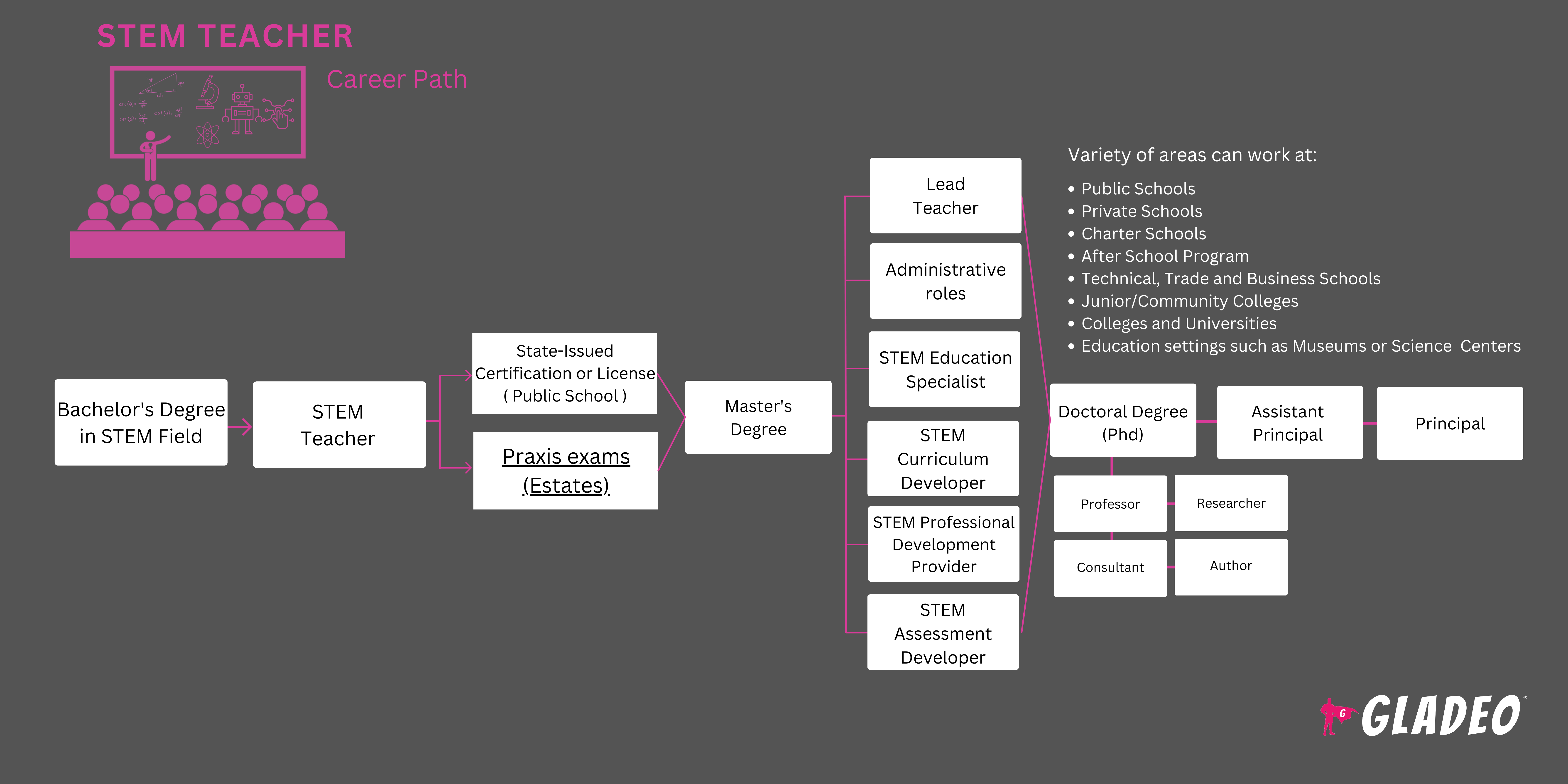
- K-12 STEM teachers can move up by teaching at advanced levels. Knock out some extra education and training, such as a master’s or a new certification to qualify
- Some teachers shift from teaching into better-paying administrative roles but would involve getting a degree in education or school administration
- If you’re a post-secondary instructor, lecturer, or adjunct, you may need to earn your doctorate degree if you want to qualify for a tenure track full professor position
- While not every college professor has a doctorate, the ones who teach STEM subjects are almost always required to have a PhD or other doctorate (such as MD or OD)
- Professors without a doctorate usually teach liberal arts have completed terminal degrees at the master’s level
- If you're a college faculty member on a tenure track, study all of the criteria and stay on top of getting your objectives knocked out as you progress from assistant to associate to full professor!
- Get specialized in a challenging STEM area like artificial intelligence by taking advanced courses
- Cuando hayas adquirido suficiente experiencia, obtén la certificación opcional de la Junta Nacional de Normas Profesionales Docentes para mejorar tu currículum.
- Be a DEI champion for student rights!
- Grow your reputation as a subject matter expert. Get published in STEM journals, write online articles, make tutorial videos, mentor peers, and participate in alumni professional organization events
- Consider making your own website or social media channel related to your area of expertise, where users can learn and share information
- Participa en comités escolares y del distrito de gran relevancia y deja huella
- Fortalecer las relaciones con los alumnos, el personal, los profesores y los responsables administrativos
- Stay creative! Explore innovates ways to teach STEM (and STEAM) subject matter to keep learners motivated
Páginas web
- ABET
- Asociación Americana para el Avance de la Ciencia
- Federación Americana de Profesores
- Sociedad Matemática de Estados Unidos
- Sociedad Americana para la Educación en Ingeniería
- Instituto Anita Borg para las Mujeres y la Tecnología
- Asociación para la Maquinaria Computacional
- Asociación para el Avance de la Inteligencia Artificial
- Asociación de Mujeres en la Informática
- Asociación de Profesionales de las Tecnologías de la Información
- Centro de Excelencia en Tecnologías de la Información y la Informática
- Profesionales de la Informática por la Responsabilidad Social
- Consejo para la Acreditación de la Formación del Personal Docente
- Sociedad de Informática del IEEE
- Instituto de Investigación Operativa y Ciencias de la Gestión
- Consejo Nacional de Normas Profesionales de la Enseñanza
- Centro Nacional para las Mujeres y las Tecnologías de la Información
- Asociación Nacional de Educación
- Asociación Nacional de Padres y Profesores
- Centro Nacional de Recursos para Auxiliares Educativos
- Sociedad de Matemáticas Industriales y Aplicadas
- TEACH.org
- USENIX, la Asociación de Sistemas Informáticos Avanzados
Libros
- Teaching and Learning STEM: A Practical Guide, by Richard M. Felder , Rebecca Brent, et al.
- Leadership in Integrative STEM Education: Collaborative Strategies for Facilitating an Experiential and Student-Centered Culture, by Rachel Geesa
- Science in the City: Culturally Relevant STEM Education, by Bryan A. Brown and Christopher Emdin
Interested in teaching, but not a STEM subject? Or maybe you want to work in a school environment but not as a teacher? There is a wide range of other careers to explore, such as:
- Asesor académico
- Profesor de educación básica y secundaria para adultos y de inglés como segunda lengua (ESL)
- Decano de Estudiantes
- Director o subdirector de primaria, secundaria y bachillerato
- Coordinador pedagógico
- Recursos Humanos
- Secretario
- Conductor de autobús escolar
- School and Career Counselor
- Enfermera escolar
- Profesor de educación especial
- Entrenador deportivo
- Superintendente
- Ayudante de profesor
- Webmaster
Sección de noticias

Ofertas de empleo destacadas
Cursos y herramientas en línea
Expectativas salariales anuales
New workers start around $82K. Median pay is $109K per year. Highly experienced workers can earn around $136K.
Expectativas salariales anuales
Los nuevos trabajadores empiezan con un sueldo de unos 0K $. El sueldo medio es de 0K $ al año. Los trabajadores con mucha experiencia pueden llegar a ganar unos 0K $.
Expectativas salariales anuales
New workers start around $82K. Median pay is $117K per year. Highly experienced workers can earn around $152K.
Expectativas salariales anuales
Los nuevos trabajadores empiezan con un sueldo de unos 69 000 dólares. El sueldo medio es de 99 000 dólares al año. Los trabajadores con mucha experiencia pueden llegar a ganar unos 129 000 dólares.
Expectativas salariales anuales
Los nuevos trabajadores empiezan con un sueldo de unos 0K $. El sueldo medio es de 0K $ al año. Los trabajadores con mucha experiencia pueden llegar a ganar unos 0K $.
Expectativas salariales anuales
New workers start around $66K. Median pay is $91K per year. Highly experienced workers can earn around $121K.