






Destacados
Seed Technician, Seed Production Specialist, Agricultural Seed Technician, Seed Quality Inspector, Seed Grower, Crop Production Technician, Seed Field Technician, Seed Development Technician, Seed Laboratory Technician, Plant Breeder Assistant, Seed Certification Technician, Seed Crop Advisor
Imagine the food you eat, the clothes you wear, and the plants that beautify parks all starting from tiny seeds carefully nurtured to grow strong and healthy. Seed Production Technicians play a vital role in ensuring that these seeds are of the highest quality, impacting food supply chains, agriculture sustainability, and environmental health.
Seed Production Technicians work hands-on in fields, greenhouses, and labs to grow, monitor, and test seeds. They collaborate with farmers, plant breeders, and quality control experts to oversee seed planting, irrigation, pest management, and harvesting. Their daily tasks include sampling seeds for quality tests, recording data, and ensuring that crops meet specific standards for purity and germination, which supports successful planting seasons worldwide.
Using specialized tools like seed sorting machines, moisture testers, microscopes, and software for data analysis, Seed Production Technicians help maintain the integrity and viability of seed stocks. Their work is crucial because it affects crop yields and helps farmers produce healthy plants, which ultimately feeds communities and supports ecosystems.
- Being part of the process that grows food and plants vital to people’s lives and the environment.
- Working outdoors and in labs, combining hands-on activities with scientific analysis.
- Collaborating with scientists, farmers, and environmental experts to improve seed quality and sustainability.
- Seeing tangible results when seeds you helped produce grow into thriving crops or plants.
Horario de trabajo
Seed Production Technicians often work full-time with schedules that vary by season. During planting and harvesting periods, they may work long hours, including early mornings and weekends, often outdoors in all weather conditions. Outside of peak seasons, work can be more predictable and may include indoor lab duties. Many are employed year-round by seed companies, agricultural research centers, or government agencies, but some work as seasonal or contract employees.
Funciones habituales
- Plant and manage seed crops according to specific guidelines.
- Inspect fields for pests, diseases, and environmental stress affecting seed quality.
- Collect seed samples and perform germination and purity tests.
- Operate and maintain seed cleaning and sorting equipment.
- Record detailed data on seed growth, quality tests, and environmental conditions.
- Assist in seed certification processes ensuring compliance with agricultural standards.
- Coordinate irrigation and fertilization schedules to optimize seed production.
- Monitor and control pest management using integrated pest management practices.
- Collaborate with breeders to identify desirable seed traits.
- Prepare reports on seed production outcomes and quality metrics.
- Maintain seed storage facilities to preserve seed viability.
- Ensure safety protocols are followed in field and lab environments.
Responsabilidades adicionales
- Train new technicians or farm workers in seed handling procedures.
- Participate in research trials for new seed varieties.
- Help develop or improve seed production protocols and standards.
- Communicate with regulatory agencies about seed certification and compliance.
- Manage inventory of seed stocks and supplies.
- Support sustainability initiatives by promoting environmentally friendly farming practices.
- Assist in equipment calibration and troubleshooting.
- Provide educational outreach or demonstrations about seed production to farmers or students.
A Seed Production Technician’s day might begin early with a field inspection, checking seed crops for any signs of pests or disease, and ensuring irrigation systems are functioning properly. They review weather forecasts and plan daily tasks accordingly to protect seed quality.
Midday is often spent collecting seed samples for testing in a nearby lab or mobile unit. They conduct germination tests or analyze seed purity under microscopes, meticulously recording results. They might also operate seed cleaning machines or troubleshoot equipment issues.
Late afternoon brings collaboration with the agricultural team: discussing progress with plant breeders, updating supervisors on seed quality, and planning for upcoming planting or harvesting schedules. They finalize reports and prepare fields or labs for the next day’s work.
Habilidades interpersonales
- Atención al detalle
- Gran capacidad de observación
- Good communication and teamwork
- Mentalidad orientada a la resolución de problemas
- Paciencia y perseverancia
- Ability to work outdoors in various weather
- Gestión del tiempo y organización
- Adaptability to seasonal work demands
- Basic math and record-keeping skills
- Curiosidad y ganas de aprender
- Responsabilidad y fiabilidad
- Concienciación sobre la seguridad
Competencias técnicas
- Seed sampling and testing techniques
- Operation of seed cleaning and sorting machinery
- Conocimientos sobre biología vegetal y ciclos de cultivo
- Registro y análisis de datos
- Familiarity with seed certification standards
- Use of microscopes and lab equipment
- Identificación de plagas y enfermedades
- Irrigation and fertilization management
- Mantenimiento básico de los equipos
- Computer skills for record keeping
- Field Technician: Focuses on cultivating and monitoring seed crops directly in farm fields.
- Laboratory Technician: Specializes in seed quality analysis, germination testing, and purity assessments indoors.
- Seed Certification Technician: Ensures seeds meet governmental or industry standards for certification.
- Research Technician: Works on developing and testing new seed varieties for improved traits.
- Seed Processing Technician: Operates machinery for cleaning, sorting, and packaging seeds post-harvest.
- Quality Control Technician: Oversees compliance with quality standards throughout seed production.
- Greenhouse Technician: Manages seedling growth and controlled environment seed production.
- Seed Storage Technician: Maintains seed storage conditions to preserve viability over time.
- Empresas de producción de semillas
- Instituciones de investigación agrícola
- Organismos agrícolas del Gobierno
- Programas universitarios de extensión agrícola
- Empresas de biotecnología
- Empresas de mejora vegetal
- Organizaciones de protección del medio ambiente
- Cooperativas agrícolas
- Seed certification agencies
- Farming operations
- Seed testing laboratories
- Actividades relacionadas con los invernaderos y los viveros
Seed Production Technicians often face physically demanding work, including standing for long periods, bending, and working outdoors in all weather. During peak seasons, they may work extended hours with tight deadlines to ensure crops are planted or harvested at optimal times.
The job requires careful attention to detail and the ability to manage multiple tasks simultaneously, especially when monitoring seed quality and documenting data. Technicians must be prepared for repetitive testing and inspections that require patience and precision.
While the work can be rewarding, it sometimes involves exposure to chemicals or allergens, so safety protocols are critical. Seasonal fluctuations in workload mean that technicians must be flexible and ready to adapt their schedules, which can impact personal time during busy periods.
- Increased use of biotechnology to develop higher-yield and disease-resistant seeds.
- Adoption of precision agriculture tools like drones and sensors to monitor seed crops.
- Greater emphasis on sustainable and organic seed production methods.
- Expansion of data analytics and software for seed testing and quality control.
- Advances in seed coating technologies to improve germination and protection.
- Growth of hybrid and genetically modified seed varieties.
- Stricter seed certification and regulatory standards.
- Integration of automated machinery for seed cleaning and sorting.
- Development of climate-resilient seed strains.
- Collaboration between seed companies and environmental organizations to promote biodiversity.
Many Seed Production Technicians discovered their passion for plants and nature through gardening, farming, or participating in 4-H or FFA programs during childhood. Hands-on experiences with planting seeds and watching them grow often sparked curiosity about agriculture and biology.
A natural interest in science, observation, and working outdoors also plays a big role. Kids who enjoy experimenting, caring for living things, and solving practical problems often find this career path fulfilling and exciting.
Becoming a Seed Production Technician usually involves a combination of formal education and hands-on training. Many start with a high school diploma or equivalent, then pursue specialized courses or certifications in agriculture, crop science, or seed technology to build foundational knowledge.
Los estudiantes pueden cursar asignaturas relacionadas con temas como:
- Introduction to Agriculture
- Biología vegetal y botánica
- Ciencia del suelo
- Crop Science and Production
- Seed Technology
- Control de plagas
- Química agrícola
- Data Collection and Analysis
- Farm Machinery Operation
- Ciencias Ambientales
Hands-on experience through internships, apprenticeships, or work-study programs is essential to develop practical skills. Building a portfolio of seed testing results and familiarity with industry standards can help candidates stand out when applying for jobs. On-the-job training is common, as techniques and equipment vary by employer.
- Join agriculture-related clubs like FFA or 4-H to gain early experience.
- Take biology, chemistry, and environmental science classes seriously.
- Participate in school or community gardening projects.
- Seek internships or summer jobs on farms or seed companies.
- Learn computer skills for data recording and analysis.
- Volunteer at agricultural fairs or seed testing events.
- Attend workshops or seminars on seed production and plant science.
- Develop strong note-taking and observation skills.
- Build teamwork and communication through group projects.
- Research colleges with strong agricultural technology programs.
- Look for programs with hands-on seed technology labs.
- Choose schools offering internships or cooperative education in agriculture.
- Verify if the program covers seed certification standards.
- Check for courses on pest management and crop science.
- Ensure access to modern seed testing equipment.
- Consider programs linked to agricultural research centers.
- Seek instructors with industry experience.
- Look for small class sizes for personalized training.
- Evaluate the program’s track record for job placement.
- Busca oportunidades para participar en proyectos de investigación.
- Look for programs that teach data analysis and record-keeping software.
- Consider online versus in-person offerings based on your learning style.
- Apply for entry-level technician roles at seed companies or farms.
- Build a portfolio documenting any seed testing or crop management work.
- Volunteer for extra tasks to gain diverse experience in seed production.
- Network with agricultural professionals through local events and online forums.
- Develop proficiency with seed testing tools and software.
- Seek mentorship from experienced Seed Production Technicians.
- Prepare for interviews by reviewing common seed production challenges and solutions.
- Stay physically fit to handle outdoor and manual tasks.
- Be willing to work flexible hours during peak seasons.
- Take additional certifications in pesticide application or lab safety if possible.
- Document your experiences and results to demonstrate your skills.
- Keep learning about new seed technologies and regulations.
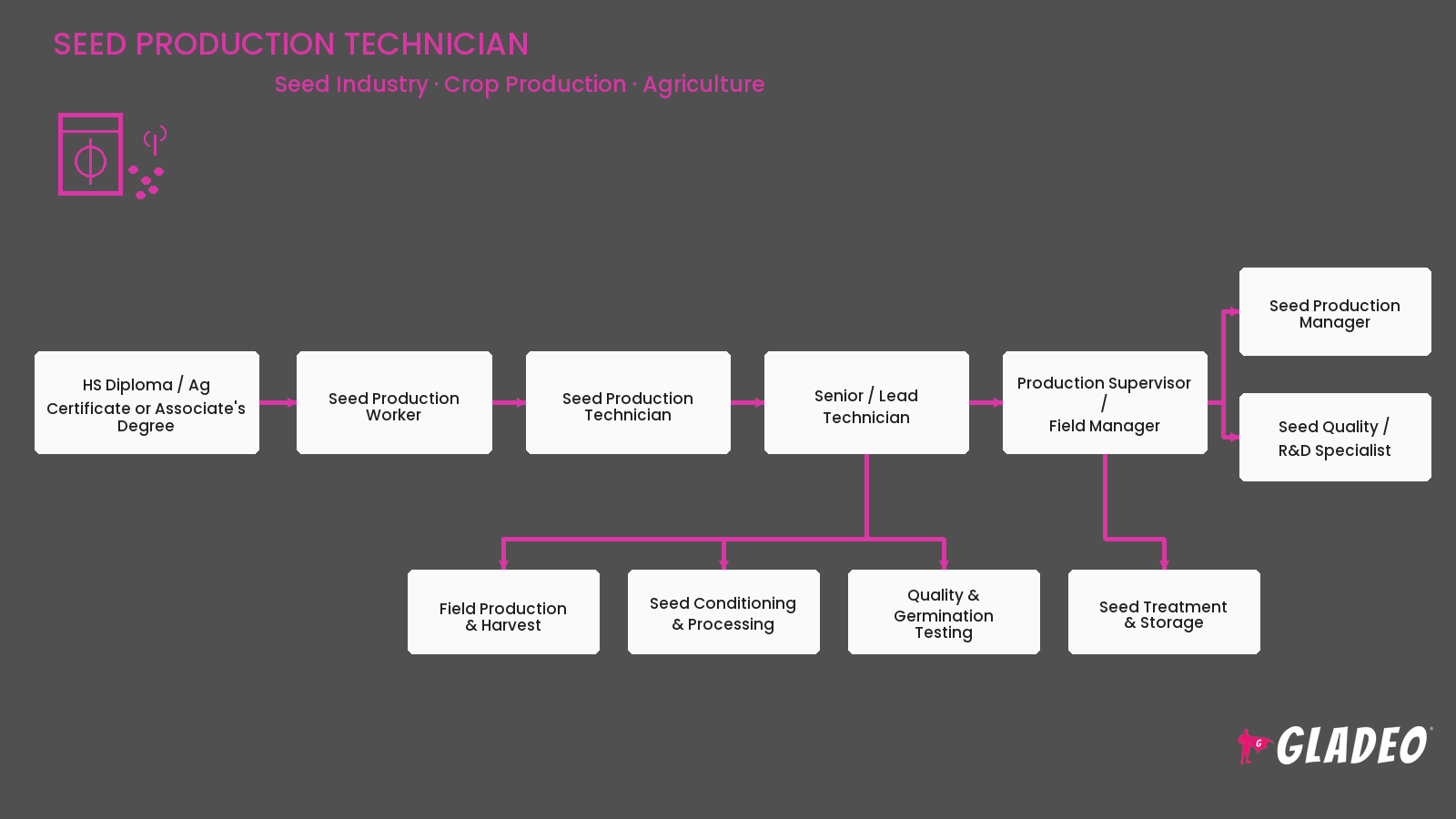
- Gain advanced certifications in seed technology or crop science.
- Develop expertise in seed certification and regulatory compliance.
- Specialize in research and development for new seed varieties.
- Move into supervisory roles managing seed production teams.
- Expand skills in data analytics and precision agriculture technologies.
- Pursue further education such as an associate or bachelor’s degree in agriculture.
- Build relationships with farmers, breeders, and industry partners.
- Stay updated on biotechnology trends to lead innovation projects.
Páginas web:
- American Seed Trade Association (seedalliance.org)
- Association of Official Seed Certifying Agencies (aosca.org)
- International Seed Testing Association (seedtest.org)
- Sociedad Americana de Ciencias Agrícolas (crops.org)
- National FFA Organization (ffa.org)
- United States Department of Agriculture – Seed Programs (usda.gov)
- Servicio de Investigación Agrícola (ars.usda.gov)
- Seed Technology Magazine (seedtechmag.com)
- Plant Breeding and Genomics Community (plantbreeding.org)
- AgCareers.com (agcareers.com)
- National Sustainable Agriculture Coalition (sustainableagriculture.net)
- Seed World (seedworld.com)
- Society of Commercial Seed Technologists (scst.org)
- Fundación Extension (extension.org)
Libros:
- Seed to Seed: Seed Saving and Growing Techniques for Vegetable Gardeners by Suzanne Ashworth
- The Seed Garden: The Art and Practice of Seed Saving by Lee Buttala and Shanyn Siegel
- Seed Science and Technology by M. K. Thompson and J. D. A. Van Staden
- Principles of Seed Science and Technology by Lawrence O. Copeland and Miller B. McDonald
- The Organic Seed Grower: A Farmer's Guide to Vegetable Seed Production by John Navazio
If you're passionate about plants and agriculture but want to explore other career options, there are many related fields where your skills and interests can shine.
- Operador de maquinaria agrícola
- Crop Scout
- Criador de plantas
- Inspector agrícola
- Científico especializado en suelos y plantas
- Responsable del invernadero
- Horticultor
- Científico medioambiental
- Representante comercial del sector agrícola
- Responsable de la explotación agrícola
Haz clic aquí para descargar la infografía
Sección de noticias

Ofertas de empleo destacadas
Cursos y herramientas en línea